Flaming Coals Dual Fuel Spit Roaster Guide
Author: Sasha Halabi
If you love cooking over charcoal but also want the option of gas when conditions are not ideal, a dual fuel spit roaster gives you the best of both worlds. At Flaming Coals, our two AGA approved dual fuel spits are built for cooks who want real charcoal flavour first, with the added convenience of gas when they need it.
These spits do not replace the experience of cooking over charcoal. Charcoal is still where that deep, traditional spit roast flavour comes from. What dual fuel gives you is flexibility. If the weather turns, if you need extra control, if solid fuel is not practical, or if you simply forgot to buy charcoal, you still have a reliable way to get the cook done.
The two main options are the Flaming Coals Dual Fuel Spit Roaster 1000 and the Flaming Coals Dual Fuel Charcoal and Gas Spit Roaster 1500mm. Both are tested and approved by the Australian Gas Authority, certification number 8631, which means they meet Australian regulatory requirements for gas safety.
Quick Answer: What Is The Difference Between The 1000 And 1500 Dual Fuel Spits?
The Flaming Coals Dual Fuel Spit Roaster 1000 is the more compact option, suited to smaller cooks up to 10kg with its included silent motor, making it ideal for chickens, rolled roasts and gyros. The Flaming Coals Dual Fuel Spit Roaster 1500mm is the larger and more powerful option, with a bigger cooking area and motor choices including 30kg, 60kg, and 120kg rated motors. It is better suited to larger roasts, lambs, small animals and bigger backyard gatherings.
Why Dual Fuel Matters
Most serious BBQ lovers still chase charcoal because it gives meat that unmistakable smoky depth. It is the reason lamb, pork, chicken and gyros taste so good when cooked slowly over coals.
Gas adds another layer of control. It can help when the weather is rough, when lighting charcoal is not practical, or when you want a quicker and more predictable heat source. With these Flaming Coals spits, you can choose gas, charcoal, or work with both depending on the cook.
That means more options without losing the spirit of open fire cooking.
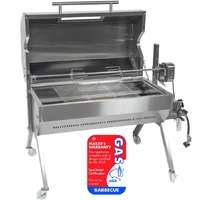
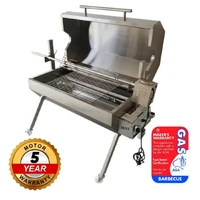
Flaming Coals Dual Fuel Spit Roaster 1000
The Flaming Coals Dual Fuel Spit Roaster 1000 is the compact dual fuel option in the range. It is designed for people who want the flavour of charcoal with the backup and convenience of gas in a smaller footprint.
This model is suited to cooking up to 10kg of chickens, rolled roasts or gyros. It comes with a 10kg silent operation motor, a one piece 10mm 304 food grade stainless steel skewer, two 304 food grade stainless steel chicken or small roast prongs, one 304 food grade stainless steel BBQ grill, two stainless steel gas burners, a charcoal pan insert and a fat drip tray.
If you want the same compact dual fuel setup with more turning power, there is also the Dual Fuel Spit Roaster Deluxe, listed as the SPG100 Deluxe. This upgrade includes a stronger 30kg motor and a 22mm skewer, giving you the ability to cook more meat with a newer, more powerful motor setup. You can see it here.
The hooded design helps retain heat, especially when cooking with gas, while the viewing window and temperature gauge let you monitor the cook without constantly opening the lid. The height adjustable skewer is especially useful when cooking over charcoal because it allows you to control how close the meat sits to the heat.
It also includes airflow holes to help maintain temperature, which is important when working with charcoal.
This model is ideal for home users who want dual fuel flexibility in a smaller spit roaster without moving into a large capacity unit.
Flaming Coals Dual Fuel Charcoal And Gas Spit Roaster 1500mm
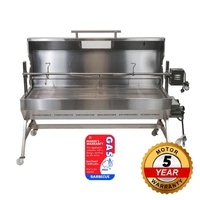
The Flaming Coals Dual Fuel Charcoal and Gas Spit Roaster 1500mm is the larger option, built for those who want more cooking space, more motor choice and more flexibility for serious backyard entertaining.
It is suitable for cooking gyros, whole chickens, lambs and small animals. It is also a strong choice for home users who want a quality dual fuel setup that can handle larger cooks with confidence.
The cooking area measures 1430mm long by 485mm deep, with 195mm skewer to wall clearance when the hood is closed. That gives you significantly more room than the 1000 model, making it the better option for bigger roasts and larger gatherings.
This unit is available with a choice of 30kg, 60kg, and 120kg rated motors, all backed by a 5 year motor warranty. It also includes a one piece 304 food grade stainless steel 22mm skewer, 304 food grade stainless steel animal prongs, back brace and leg bracket, two 304 food grade stainless steel BBQ grills, two full length stainless steel gas burners, piezo ignition, a charcoal pan insert and a fat drip tray.
Like the 1000 model, the 1500mm version features a hooded design, viewing window, temperature gauge, airflow holes and adjustable skewer height. These features give you better control when cooking over both gas and charcoal.
Key Similarities Between Both Dual Fuel Spits
Both models are designed around the same core idea. Cook with charcoal when you want that traditional flavour, or use gas when you need convenience and control.
Both models include stainless steel construction, a hooded design, a viewing window, a temperature gauge, airflow holes, stainless steel burners, a charcoal pan insert and a fat drip tray.
Both are also AGA approved under certification number 8631. Flaming Coals sends samples to the AGA laboratory in Melbourne annually for inspection, helping ensure ongoing compliance with Australian regulatory requirements.
That safety approval matters. Gas appliances should always be tested and certified properly. When buying a gas spit roaster, always check the certification number and look for the correct gas approval markings.
Some other gas spits you will see out there are not AGA approved, meaning there is no warranty and no safety check with them, so be careful.
Key Differences Between The Two Models
The biggest difference is size and capacity.
The Dual Fuel Spit Roaster 1000 is compact, easier to manage and suited to smaller cooks.
The Dual Fuel Spit Roaster 1500mm is longer, larger and designed for heavier cooking. It’ suited for entertaining a party, cooking a whole animal, or having that extra space when you want to cook something big.
Both are great, but it comes down to what suits you as a cook best.
When Gas Is Useful
Charcoal is still the hero for flavour, but gas can be genuinely useful.
Gas can help when the weather is rough, when you want a faster start, when you need consistent burner heat, or when solid fuel is not allowed in a certain setting. It can also make the cook more manageable if you are entertaining and want less hands on fire management.
The beauty of these dual fuel spits is that you are not locked into one method. You can lean into charcoal when flavour is the priority, or use gas when convenience matters most.
When Charcoal Still Wins
For traditional spit roasting, charcoal still delivers the flavour most people are chasing. It gives lamb, pork, chicken and gyros that smoky finish and roasted depth that gas alone cannot fully replicate.
The height adjustable skewer on both models gives you control over how close the meat sits to the charcoal. That means you can raise or lower the food depending on heat intensity, helping you manage the cook properly instead of simply hoping for the best.
If your goal is maximum flavour, start with charcoal. If your goal is convenience and backup control, gas gives you another option.
Final Thoughts
A dual fuel spit roaster gives you options. Charcoal brings the flavour. Gas brings convenience. Together, they create a setup that can handle more situations, more cooking styles and more backyard events.
The Flaming Coals Dual Fuel Spit Roaster 1000 is compact, practical and perfect for smaller cooks. The Flaming Coals Dual Fuel Spit Roaster 1500mm is larger, more powerful and built for bigger gatherings.
If you want a spit roaster that gives you genuine flexibility without walking away from charcoal cooking, these two AGA approved Flaming Coals dual fuel models are the place to start